

















We have our first computer model Tiger tip! It’s from Matter of Stats.


AFL Prediction & Analysis
We have our first computer model Tiger tip! It’s from Matter of Stats.
Squiggle trades in cold, hard data, so there will be no place in this post for barracking or bandwagoning. Sure, outside of this thread, I may be clicking LIKE hard and often on every pro-Richmond post I see. Sure, this is the first time Richmond have made the Grand Final since I was 9 years old, and my parents took me to the Royal Melbourne Show on Grand Final Day because it was less crowded. “You can watch the next one, Max,” they told me, and you know what? I bloody well will. I have a ticket and I am going. Sure, there were times when it felt like this would never happen in my lifetime. But you won’t catch me mentioning any of that here.

Both favourites won their prelims comfortably. But Adelaide were more impressive in defeating the Cats 136-75, while in PF2, or as squiggle knows it, “Who Wants To Be Slaughtered By Adelaide,” the Tigers ended the Giants 103-67.

That result leaves the Crows approaching somewhere near the gravitational centre of the squiggle’s premiership cups, which means their 2017 results are similar to those of many premiership teams from the last two decades. They’re still somewhat modestly rated for a premier, but they’re not far off it.
The Tigers, on the other hand, are a more niche model, belonging to a distinct class of teams with strong defences but mediocre attacks. That does include a few premiers, most notably the reigning premier (for a few more days, at least) in the Western Bulldogs, but many more who fell short, including a swag of Ross Lyon-coached teams.

Adelaide’s year bears a striking similarity to 2016, when the Crows also opened with a series of blisteringly high-scoring games, then began to tighten up defensively as well:
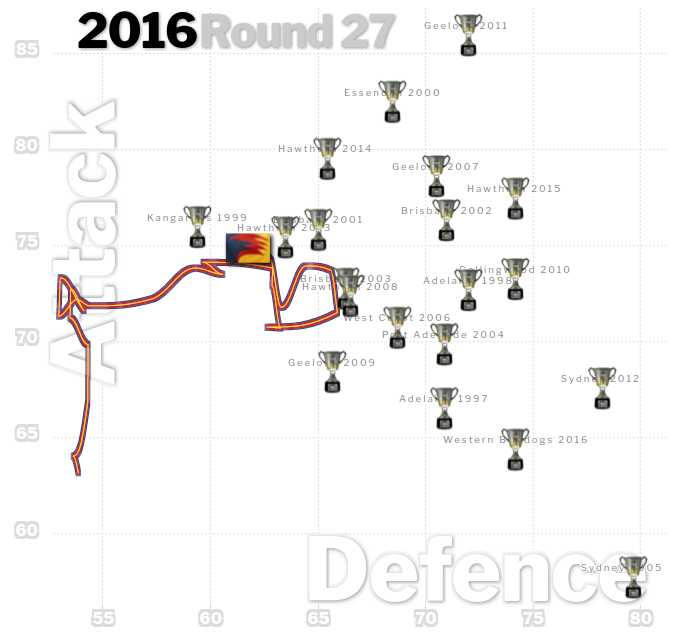
The Crows were squiggle darlings for most of last year before wobbling late and falling to the Swans in a semi-final that psychologically scarred Adelaide-based squiggle fans for all time. They still don’t look enormously different to that team, but they’re better balanced and the opposition standing in their path to a flag has been weaker, with GWS in particular less dangerous than the 2016 version.
The 2016 semi-final loss is interesting in light of this year’s Grand Final, because the 2016 Swans and 2017 Tigers look to have a bit in common, with both enjoying low-scoring slugfests. So one might wonder whether the Crows have a weakness in that area that the Tigers are designed to exploit. But by moving into the more balanced area of the chart, Adelaide are showing they’re more well-rounded and less brittle, better able to deal with a variety of game plans.
Fun Fact: Both Port Adelaide and Essendon remain eligible for a classical 4-Strike, by losing an Elimination Final to a team that lost a Semi-Final to a team that lost a Preliminary Final to a team that loses a Grand Final.
Squiggle is unique in placing a particular emphasis on attack-defence balance. Computer models commonly produce a single “strength” number and tip whoever’s strongest. Squiggle does this for all games except the Grand Final, where it leans heavily toward the team with the stronger attack, due to the over-representation of that trait in past premiers.
Without this, Squiggle would still tip Adelaide, as the overall better team, but far less emphatically.

Not only is Adelade the better-rated team, and not only do they have the better attack, but they’re also more balanced. Most Grand Final upsets have happened to unbalanced teams, such as Sydney 2016 (defensive specialist) and Hawthorn 2012 (attack specialist), and there are quite a few near-misses as well, like a well-balanced Port Adelaide coming within 3 points of attack-first Hawthorn in a 2014 prelim, and Geelong doing almost the same thing against the Hawks a year earlier. So while it’s been more rewarding to be a team that engages in high-scoring games rather than low-scoring ones, it’s also been preferable not to be too far one way or the other.
There are exceptions: The Bulldogs should have lost to GWS in last year’s prelim, according to this theory, and Geelong shouldn’t have lost to anyone in 2008. But in general, it’s ideal to be the best overall, the best attack, and the most balanced – and compared to Richmond, Adelaide are all three.
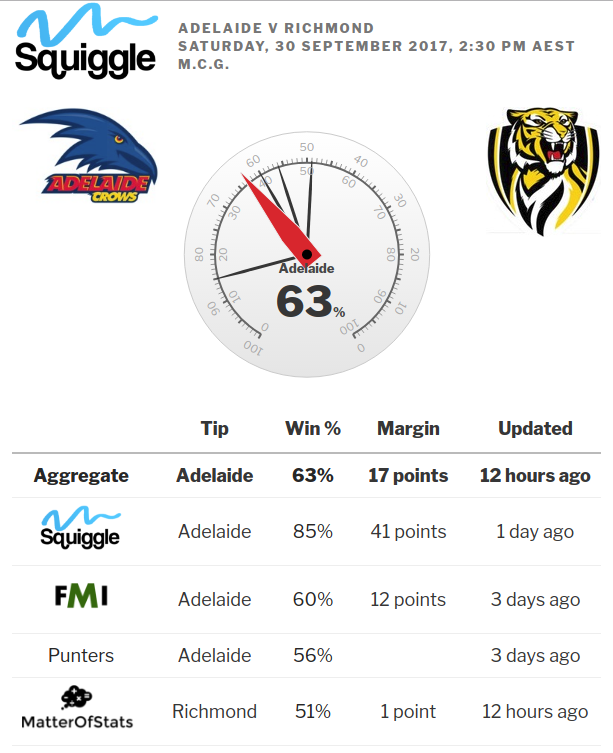
As such, Squiggle is very heavily into Adelaide, tipping the Crows by 41 points.
But that doesn’t mean the Tigers have no hope. While most of the Squiggle stable of algorithms are tipping Adelaide, there’s a healthy contingent of counter-tips from venue-based models, many of which take special note of Richmond’s amazing record at the MCG this year. That stable contains 202 algorithms at last count, and of the 36 that favour the Tigers, all of them pay special attention to the venue, either in the form of general interstate home ground advantage or results at the ‘G in particular.
That’s because Richmond haven’t had a bad match at the MCG since Round 8, when they lost after the siren to Fremantle. There were really only two Tiger embarrassments this year: one at the hands of the Crows at Adelaide Oval and another courtesy of the Saints at Docklands. But at the ‘G, Richmond have gotten better almost with each passing week. Their record since the bye looks like this:
That compares favorably to the Tigers’ record away from the MCG, which is still good but shakier, including the aforementioned St Kilda humiliation as well as a loss to at Kardinia to Geelong.
The Crows’ record at the MCG over the same period is:
Their only other game there this year was a 24-point defeat of the Hawks in Round 2. So if you believe that the venue makes a difference, there’s plenty of reason to think it will strongly favour the Tigers. And it’s been a good year for venue algorithms: they’ve actually been the most accurate of the stable this year, both in terms of tips and average margin predictions. They don’t have the same long-term record, but they have had the better read in 2017.
It’s also worth mentioning that Squiggle has underrated Richmond all year, as it did with the Bulldogs last year. When a team improves quickly over a short period, as the Tigers have in rising from a 13th-placed finish last year, Squiggle takes time to be convinced they’re the real deal, since that kind of radical change is unusual, and more commonly signals a team that’s temporarily overperforming and will soon revert to their natural level. If the Tigers really have become a lot better at football in a short period, they may still be underrated.
In terms of similar Grand Finals, 2017 bears the most resemblance to 2006, when West Coast (a well-balanced and modestly rated team) defeated Sydney (a defensive specialist) by 1 point:

That was, of course, one of the great all-time cracking Grand Finals, so we’d be blessed to get anything like a repeat.
In summary: Adelaide are deserved favourites, and have the ability to kick away and win by a significant margin. But any footy follower knows anything can happen in football, and there’s room between a 15% chance and a 0% chance to drive a premiership cup through. If the Crows don’t break free from the Tiger stranglehold and get locked down into a scrappy, high-pressure series of ground contests; if they kick inaccurately; if the venue plays a role; then it will be a Richmond premiership.
P.S. I just wanted to finish the post with the phrase “Richmond premiership.”

Animated!

Geelong were so impressed by the 90 to 40 thing that Richmond did that they tried it on the Swans. And it worked!
This was a wild upset in the most obvious sense, because Sydney haven’t looked like losing a game for a long time, unless they were playing Hawthorn. But it was also something of a typical 2017 performance for Geelong, who have spent the year backing up weak performances with strong ones, and vice versa.
What that means, I’m not sure. But it was a real shocker for the Swans, who have been so good, they’re still ranked #1 on regular form even after that pasting. But it’s time to lower their flag:

The Giants looked a different team as well, after trialling a new game style where they actually look interested in football. This is a bit alarming because they were pretty good even before they got interested in football. The Eagles, however, retreated back to their squiggle nest where they’ve spent the entire season. This could really be the least squiggling from a starting point ever.
Still, both the Giants and Cats are positioned quite a way outside the premiership area, with only two games to make up ground. Richmond are closer, but are lower-scoring, which, as discussed above, has proven problematic for teams in the past.
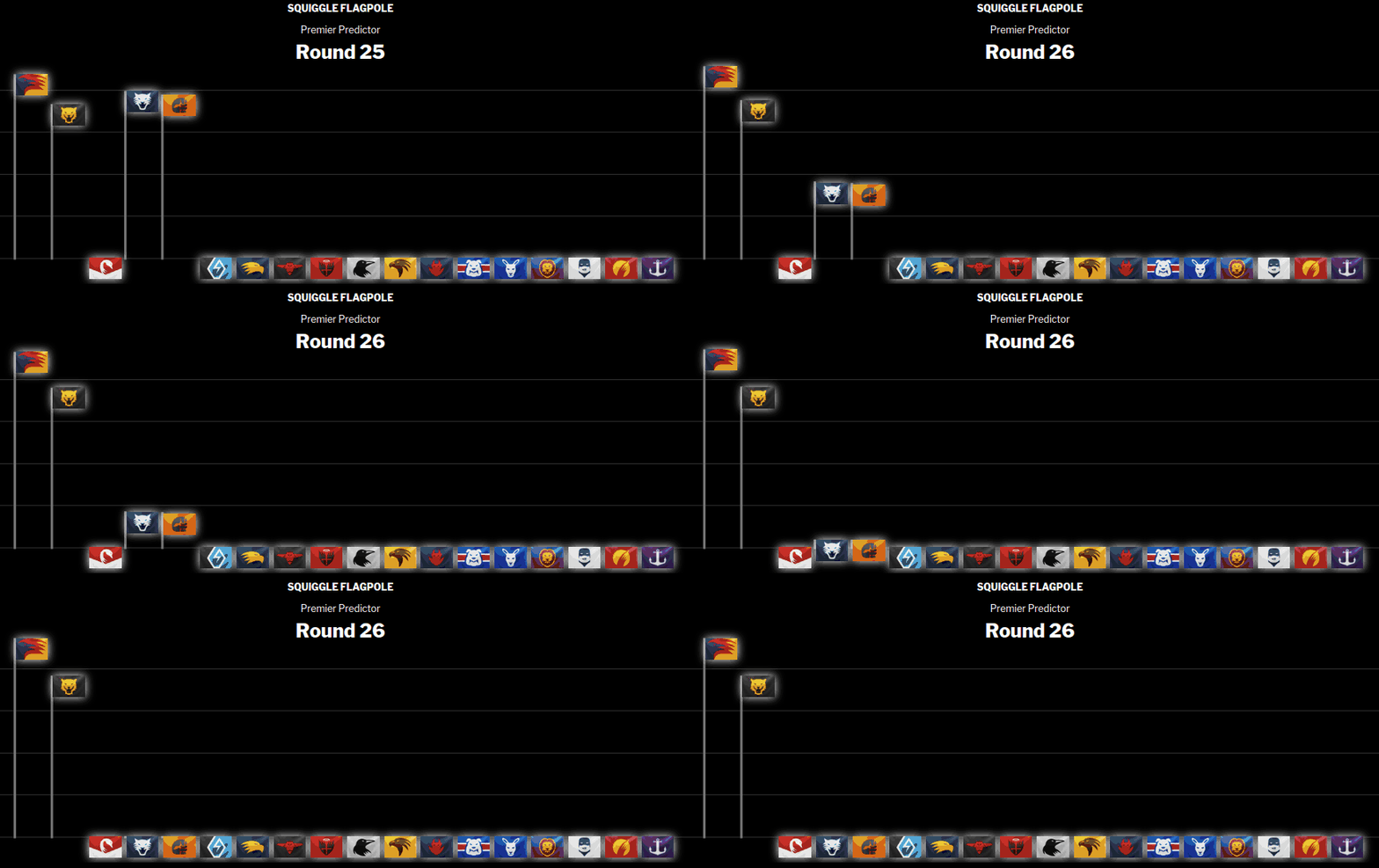
With Sydney out of the way, it looks like Adelaide in a canter.

That said, it’s worth remembering how probabilities work, and that a 70% chance of a win followed by an 80% chance of a win sounds like something approaching a sure thing, but in truth it’s close to a coin flip (0.7 x 0.8 = 0.56) as to whether Adelaide takes out the flag or not.
Also, while Adelaide have been ranked #1 by flagpole non-stop since Round 1, they haven’t gotten to the heights reached by teams like Hawthorn, Geelong and Collingwood of years gone by. They’ve been the best team all year, but not by a whole lot. It would be a real surprise for the Crows to lose from here, but not a shock.
Adelaide Crows vs Geelong Cats

Richmond Tigers vs GWS Giants

Looking at the Flagpole at the moment: why is Geelong ranked so much higher than Richmond despite Richmond being ranked ahead of them in both offence and defence?
Because Richmond is in an area of the chart where good teams go to not win premierships.
Over the last twenty years, only three teams have done it from there: Bulldogs 2016, Sydney 2012 and Sydney 2005. All were upsets. Two were huge upsets, part of a series of other upsets.
Meanwhile, it’s been a graveyard for otherwise strong teams who failed to go all the way: Sydney 2016, Sydney 2015, Richmond 2015, Fremantle 2015, Sydney 2014, Fremantle 2014, Fremantle 2013, Sydney 2013, Fremantle 2012, St Kilda 2011, St Kilda 2010, Adelaide 2010, St Kilda 2009, Adelaide 2009, Sydney 2006, Adelaide 2006, Adelaide 2005, Sydney 2004, Geelong 2004, and Carlton 2001. I suppose I should add Sydney 2017 now, too.
Flagpole is different to the regular squiggle algorithm because it’s slanted to favour teams that look like past premiership winners, and not like teams that win games but not flags. That basically means it prefers teams with a strong attack, and dislikes teams that look like they’re being coached by Ross Lyon.
This is all done without any special reasoning; i.e. squiggle offers no theory on why, exactly, defensive specialist teams have done poorly in finals after successful regular-season campaigns. It just notes that they have, and expects the trend to continue. The landscape today may look very different if St Kilda had snagged a couple of flags in 2009 and 2010 and if Fremantle had managed it in 2013. But they didn’t, so this is the historical reality, which Richmond need to overcome.

a.k.a. “Richmond goes wheeee!”

Throughout the season, the squiggle refused to rate Richmond any higher than a somewhat-above-average team. Now there are only six teams left, the Tigers are rated 3rd, i.e. still just on the better side of average. But they made a big move after holding Geelong to only 40 points, essentially pulling level with Adelaide in terms of raw form.
That’s still not enough for a flag, because squiggle respects the historical fact that attacking teams have outperformed defensive teams when it counts over the last two decades. So while the Tigers have a dream run to the Grand Final, avoiding both top teams and hosting an interstate opponent for a prelim, squiggle doubts they can contain the scoring power of Adelaide or Sydney if they get there.
Nevertheless, the Tigers are certainly close enough to give it a shake, which is just about the most exciting thing I’ve experienced in my entire football-following life. So that’s something.
There’s not a whole lot to say about Adelaide v GWS or Sydney v Essendon, both of which played out to expectation.
But Port v West Coast! Once again, the Power failed to knock off a well-rated opponent, although only just, in the cruelest possible way. Taking an 8 scoring shot advantage and turning it into 2 fewer goals and 10 more behinds is going to sink any team.
Despite all the evidence Port has offered to the contrary, there’s still reason to believe they’re a very good team, and if they can avoid self-immolating over the off-season, they could follow in the footsteps of Sydney 2015, who kicked themselves out of their first final against Fremantle (7.18 to 10.9), then rebounded the next year to win the minor premiership and contest the Grand Final. Port’s stumbles in 2017 have been absurd, dramatic and memorable, so it’s easy to forget they annihilated the bottom tier of the competition, beat most of the middle tier, and weren’t too far off the rest, while recording wins over Sydney and West Coast.
Meanwhile, the Eagles are lurking just close enough to be dangerous. All year, they’ve been thereabouts, competitive in practically every game, including those against everyone they have to beat for the flag. They are rightly underdogs, but having landed on the soft side of the draw, it’s not beyond the realm of possibility that the Eagles could defeat the Giants, who they only lost to by 8 points earlier this year, then Richmond, who they lost to by 11, and then take on Sydney or Adelaide, both of whom they’ve beaten.
An Eagles flag would be mind-boggling, given they were unlikely even to make finals a few rounds ago. In another year, I’d say it was fanciful, because normally we have at least one truly dominant team plus a tradition of rested Qualifying Final winners beating up Semi-Finalists. But this year, our top two in Adelaide and Sydney haven’t created as much separation from the field, you only have to beat one of them (unless you’re Geelong), and there’s the unknown quantity of the pre-finals bye in play. So almost anything is within the realms of possibility.
On flagpole, it’s bombs away and lights out!

Richmond squeak into 3rd even with the heavily defensive game plan that Flagpole abhors. And Geelong are still rated pretty well, even though in the real world everyone has concluded that they are the worst football team to ever play the game and who will win that Adelaide v Sydney prelim.
Geelong Cats v Sydney Swans

There’s a long history, of course, of people overrating Elimination Final winners and underrating Qualifying Final losers. But it’s still hard to see Sydney dropping this one: They’re a premiership favourite who finished much lower on the ladder than their form suggested, while the Cats made top 4 on the back of a few close wins and didn’t fire a shot against the Tigers.
GWS Giants vs West Coast Eagles

This one is harder to pick, with neither team having stood out over the season, but both also refusing to go away. In a neutral venue, squiggle would pick the Eagles, but only just; in NSW, it gives it to the Giants.

I’m just going to stare at that for a while now. I basically made that Squiggle Doors function just so I would have an excuse to imagine Richmond Grand Finals in alternate universes. Now there might be one in this one! That’s even better.
By the way, I would also like to take this moment to enjoy when hardly anybody has started hating Richmond crowds yet. I know that’s coming, because Richmond crowds when the Tigers are on the verge of success are the fucking worst. Not for me. They’re fine for me, because I’m wearing yellow and black. But for other teams’ supporters. I didn’t see anything bad at the Geelong game, but I’ve been to every final of the last five years, and they bring out plenty of mentally damaged individuals who have been psychologically broken by the last 35 years of heartache and now clearly believe they are the plaything of a malevolent deity who can only be banished by a spray of alcohol-fueled insults. If we make a Grand Final, it’s going to be so ugly. I mean win or lose, either way, there is going to be some shit on display. So it’s nice to get in before that.
2017 has been a rough year for tipping, even tougher than 2016, which itself was a wake-up call after the lovely, predictable Hawthorn dynasty.
Sadly, none of the models managed to outperform the bookies in tipping winners head-to-head during the Home & Away season, nor in terms of probabilistic Bits.
| Tips | Bits | MAE | Correct | |
|---|---|---|---|---|
| Punters
4 8 4 7 7 6 3 5 5 7 4 4 3 7 5 5 7 6 6 9 8 7 5 |
132 | 22.1970 | 66.7% | |
| PlusSixOne
5 8 4 7 6 6 3 5 6 7 3 3 2 8 5 7 7 5 6 5 8 7 6 |
129 | 17.9055 | 28.89 | 65.2% |

5 9 4 6 7 6 3 5 4 7 4 3 2 6 5 5 6 7 7 8 6 6 7 |
128 | 17.5804 | 64.6% | |

3 8 5 6 7 7 4 5 4 7 4 1 3 6 4 6 8 7 7 8 6 6 6 |
128 | 16.3202 | 28.87 | 64.6% |

5 7 5 6 6 6 4 5 7 7 3 2 3 7 3 5 7 5 7 7 7 7 7 |
128 | 15.4157 | 30.11 | 64.6% |
| Aggregate
5 8 4 6 7 6 3 5 5 7 3 3 2 6 4 5 7 6 7 8 7 6 5 |
125 | 20.1305 | 28.92 | 63.1% |

5 7 5 6 6 6 3 5 5 7 3 3 3 6 4 6 7 6 6 7 7 6 6 |
125 | 16.5200 | 29.03 | 63.1% |

4 7 4 6 7 6 3 5 5 7 4 3 2 6 3 5 6 6 7 8 8 6 5 |
123 | 18.6520 | 28.73 | 62.1% |
|
5 8 5 5 5 6 3 5 5 8 4 2 2 7 3 6 7 6 6 7 6 5 6 |
122 | 17.0455 | 29.79 | 61.6% |
A particularly rough year for Squiggle’s in-house tipping algorithm, which came in dead last and didn’t deserve to be any higher. But very credible performances elsewhere, especially from Plus Six One (for the second year in a row), and it’s worth noting The Arc‘s chart-topping Mean Average Error in a year when the line-ball games didn’t fall their way.
I was curious this year to see what kind of performance the Aggregate would have, where it represents a simple average of everyone else’s tips. Would there be some kind of wisdom of the crowds effect, where it could outperform most of the individual models that provided its inputs? Well, kind of: It landed mid-table in terms of tips and MAE, but with more Bits than all models. So there could be something there.
Apologies for finals tipping being a little shaky at the moment: Apparently everyone (including Squiggle) uses different formatting for posting their finals tips, and squiggle-bot needs to learn how to parse it.

There’s been a clear top 2 for a while, and it’s Adelaide and Sydney, who are the first and sixth teams on the ladder. If it were one year ago, everyone would be writing Sydney off, as no team had ever come from outside the top 4 to make the Grand Final, let alone win it. But the Bulldogs changed that, and then spent this season dropping hints that it wasn’t because they had become a superstar team without anyone noticing.
So it’s all bets off, as far as I’m concerned, and current form is king.
Adelaide Crows v GWS Giants

The Crows started the year with a series of high-scoring matches, propelling them vertically up the chart. Then before you could say “premiership favourite,” they were humiliated in consecutive matches by a Spoonbowl contestant and a team that didn’t want to play finals if it meant having to beat Collingwood.
Since then, though, Adelaide have toughened up defensively while retaining most of their attacking power.
The Giants began the year as the second-ranked team and fell as injury bit. They could easily have finished outside the top 4, but managed to scrounge together enough close wins and draws to give themselves a straight shot at a Grand Final. It’s been that sort of year for GWS, with few outstanding performances and plenty of shaky ones that haven’t cost them.
Geelong Cats v Richmond Tigers

We need to zoom out a bit further for this one, because Richmond started the year ranked as a bottom 6 team. That means that not only did they have a bad 2016, but they didn’t show anything toward the end of the year that suggested a rise was on the cards, either. But rise they did, becoming a low-scoring but defensively formidable team. And in the final two games, they showed some attacking power as well.
The Cats are in a similar area, but have trod a far more meandering path, with a season that was never too good nor too bad for too long. They’ve demolished poor teams and recorded solid wins over good ones, but also had a raft of eyebrow-raising performances, such as losing to Gold Coast and squeaking home against Fremantle and North Melbourne. As such, it’s hard to draw a steady bead on the Cats, or find anything like a trend.
Sydney Swans v Essendon Bombers

Hard to say which line is more extraordinary: Essendon’s emergence from the absolute bottom to reach finals, or Sydney’s tale of a season in two parts. The Swans were never quite as out of form as their ladder position of 16th at the mid-season bye suggested, but there’s a clear inflection point here, with an early slide arrested and then dismissed as if it never happened. Since Round 7, the Swans have become once again a completely typical Sydney side, of the kind that made the Grand Final in 2014 & 2016 and won it in 2012. There’s an alluring discipline about them, with no really head-scratching performances after those first 6 rounds.
Essendon similarly took 7 rounds to really get going, notwithstanding their emotion-charged Round 1 win over the Hawks. They’ve made finals on the back of a mid-season stretch that saw them account for Geelong, West Coast, Port Adelaide, and St Kilda, during which time they also didn’t fall too short of Sydney, GWS, and Richmond. The last month has been shakier, though, with the Bombers losing comprehensively to Adelaide and the Bulldogs, while not showing terribly much against Gold Coast and Fremantle.
Port Adelaide Power vs West Coast Eagles

All year the Eagles have delivered roughly what you would expect: sometimes a little more, sometimes a little less, but never too far beyond expectation. They stand in stark contrast to Port Adelaide, who, when they’re on, are very, very on. When they’re off, Port are still usually competitive, but it’s that gap between their regular setting and the turbo charge switch they flip against lower sides in Gold Coast, Fremantle, Brisbane, and Carlton that has earned them the “flat track bully” moniker.
That’s probably undeserved, even though they haven’t proved it yet. The Power have been a candidate for Top Four for most of the year, holding the league’s second-best percentage, while the Eagles have spent it skirting the fringes of the Eight. If the results of other games had gone only slightly differently, Port could easily be playing a Qualifying Final this weekend with the Eagles players on holiday.

Animated!

You know I don’t believe in the whole idea of Flat Track Bullies, but god damn, Port Adelaide, you are making it difficult. The Power grew ten feet tall upon spotting a spindly, bedraggled Gold Coast, and proceeded to pound the snot out of them, while periodically stopping to flex and grin at nearby girls, and slicking back their hair with a comb. God damn you, Port Adelaide. That’s so uncool.
When Sydney curb-stomped their bottom-4 opponent, they had a little class. They were positively gentlemanly in allowing Carlton to kick 8.9, compared to the Power’s nipple-cripple of the Suns that permitted just 3.2 20.
Port Adelaide’s performance was mainly impressive for its miserliness, since scoring 135 against Gold Coast isn’t that special. It’s only 30 points more than the average team puts past the Suns. As such, the Power go shoooooting off to the right, but don’t climb much vertically. The Swans, on the other hand, see mainly vertical gains after scoring 138 against a significantly better defense.
Gold Coast finish the year as the worst-ranked team, seeing off a challenge from Fremantle.
The Cats and Tigers both had impressive wins. After some accurate goal-shooting against the Saints, Richmond are almost starting to look like a normal team, i.e. one that can score. In fact, the team that Richmond most resembles right now is Geelong, so it’s fitting that they get to Highlander it in a Qualifying Final.
I hope you appreciated my cool detachment in that previous paragraph. I’m like, sure, I write about Richmond making a QF all the time. No biggie. You can’t even tell I have my legs crossed like super tight.
And now for Melbourne. I take no joy in Melbourne. It’s a bit surprising because I was really pissed at Melbourne after the whole Jordan McMahon game thing. But no, apparently I have no more schadenfreude to give. This one sucks, Melbourne. Here is the tragedy of Melbourne in tower form:

And on Flagpole:

Is now a good time to mention that Squiggle was tipping a Swans v Adelaide Grand Final before the start of the year? I feel like yes.
Still no freaking love for the Tigers.

Last year, Squiggle had an impressive 67% hit rate in tipping finals that didn’t involve the Western Bulldogs. After including the Dogs, it was a bit less impressive, going 3-6 (33%). But 2016 was a strange year; the home (higher-placed) team has won finals regularly since 2000, going at about 72%. So you’re normally pretty safe backing them.
Finals previews to come sometime!

The most exciting thing that happened this round was the stars aligning for North Melbourne to play Brisbane for last place on the ladder. As such, today’s commentary will be heavily Spoonbowl-tilted.

Look at those two teams, heading for each other like they knew this day was coming. It’s a club on the rise vs a club that rose to half-mast in the first 10 rounds before deciding it was all too hard:

Let’s also take a moment to appreciate that these aren’t the two worst teams. The worst teams are Fremantle and Gold Coast. A Spoonbowl involving Fremantle and Gold Coast would be genuinely terrible. What Brisbane and North Melbourne offer us, by contrast, is a real chance of a decent game. You know how people are always suggesting insane changes to the finals, like wildcard playoffs between 9th to 12th: Spoonbowl 2017 offers a glimpse into that world, where deeply flawed but not completely inept teams battle for something not really that great but still a lot better than the alternative. That is Spoonbowl 2017.
North Melbourne don’t deserve the wooden spoon: For the first half of the season, they were about as good as Melbourne is now, but without winning any games. In the first five rounds, they fell 1 point short of Geelong, 3 points short of the Bulldogs, and got done by 5 points in Perth by the Dockers. In fact, in four games against the Dogs & Dockers this year, North Melbourne have managed to lose the lot by a combined total of 13 points. They have a percentage of 84.8, which is better than four other teams, and not far off Hawthorn (89.8).
Brisbane don’t deserve the spoon, either. Their second half of the year has had a clear upward trajectory, which defies the basic concept, which is that spoons are for terrible teams in terrible situations with no future so sit down and have a cry and a spoon. Other teams have tried to mess with this in the past, by “strategically” “moving” their “players” at “key moments” in order to “fucking cheat,” but Brisbane is the lighter side of that: a side on the rise that’s genuinely tried all year.
Remember that neither of these teams care a whole lot about defending, and it will be glorious. It will be a beautiful, amazing game.
Tip: Brisbane 110 – 104 North Melbourne
In other news:

Richmond finally generated a decent score, albeit against an indecent team. The Tigers are a little flattered by their accuracy in kicking 25.5, and the chart can’t adequately capture the way Fremantle players spent the second half jogging half-heartedly around the field like they were thinking about the load of laundry they had to do when they got home and whether they needed to stop off for milk. Still, it was a great performance by the Tigers, and made even clearer their year-long improvement.
We didn’t learn a whole lot from Adelaide vs Sydney, other than that it was about as competitive as expected. The Crows shouldn’t be too unhappy with that game, which they lost only due to some wayward goalkicking.

Essendon should be unable to cock up a finals berth from here, since they host the Dockers next week. And the current top 4 and top 8 will more likely remain unchanged. But there’s a crazy raft of possible scenarios on offer:

Richmond have a big chance of finishing 3rd (if they defeat St Kilda) and 6th (if they don’t). They are much less likely to finish 4th or 5th, because Port and Sydney have highly winnable games and will overtake them.
Similary, North Melbourne will probably finish 15th if they win Spoonbowl 2017 and 18th if they don’t.
If Melbourne and Essendon don’t claim 7th and 8th, the Eagles are most likely to slip in there, but it’s still possible in a benevolent universe for the Bulldogs and Saints.
Only the Giants can take top spot from Adelaide, and this scenario requires them to defeat Geelong at Kardinia while the Crows do a repeat of 2016 and drop their final game to West Coast.
The top 6 cannot change; that is, no-one currently lower than 6th can break into it, and none of the top 6 can fall out of it.
Similarly, the block of teams currently 7th to 11th is fixed, with only the order within that block still to be decided.
Here’s an animated tower, which shows Carlton’s last-minute leap to safety, and the final snuffing of Hawthorn:

Flagpole this week is mostly notable for Richmond’s little jump and some new clarity around who’s likely to play finals:
