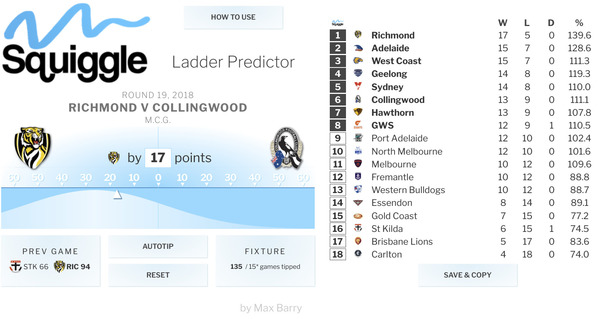
Squiggle Ladder Predictor

The official AFL ladder predictor has a few problems:

  • Not available until late in the season
  • Requires ten thousand clicks to complete
  • Created by Telstra monkeys in 1994

So I made a new one!

Squiggle AFL Ladder Predictor

Squiggle AFL Ladder Predictor

Now you can tip as few or as many games as you like and lean on the world’s best computer models to fill in the rest.

You can even go back and change some of the computer tips if you want.

I believe the world is a better place when people can generate wildly optimistic ladder projections with ease.  At the moment it’s only for the home & away season, but I’ll probably add finals sometime later.

How AutoTip Works

The Predictor fetches data from the Squiggle API, including Aggregate tips from computer models such as The Arc, Matter of Stats, FMI, HPN and many more. This provides a tip for each match as well as a confidence rating about how likely the team is to win.

It’s no good to simply tip the favourite in each game, though, because in real life, favourites don’t always win. For example, if two people play 10 games of chess, and one player is 60% likely to win each match, we want to be able to predict that the final tally will be about 6-4, and not 10-0, like we’d get if we tipped the favourite to win each time.

So AutoTip runs several thousand simulations, each time applying an amount of randomness to the predicted result, so that a team that is 70% likely to win a match will only win it in about 70% of simulations.

The simulations are then analyzed to determine the average finishing rank, number of premiership points, and percentage of each team.

This provides a pretty reliable estimation of where each team is likely to wind up on the ladder. However, we don’t merely want average numbers: We want to see specific tips for each game. So next AutoTip scores each simulation based on how closely its ladder resembles the average. Then it selects the “most normal” one.

This means AutoTip will contain many upsets, and which upsets they are will change each time. But the upsets will be spread around evenly, so that each team finishes the season about where they’re expected.

Richmond v Daylight

Richmond have been doing two things Squiggle particularly likes: Holding oppositions to low scores, and generating plenty of scoring shots.

The Tigers have been kicking plenty of behinds this season right from the start: In Round 1, they defeated Carlton by 4 goals and 14 behinds, while in losing to Adelaide the following round, they lost by 6 goals and 0 behinds.

On the surface, that’s a close-ish 26 point win followed by a heavier 36-point defeat; in terms of scoring shots, it’s a +16 smashing followed by a much closer -6.

Squiggle’s model considers the reality to be somewhere in between. As a result, it considers the Tigers’ only loss of the season so far to be a relatively close one, away interstate to a very good team – the kind of game that even a top team will often drop. The Tigers’ wins, on the other hand, have included some extraordinary smashings when viewed in terms of scoring shots.

Richmond’s opposition to date has mostly included mid- to upper-tier rated teams in Adelaide, Collingwood, Hawthorn, and Melbourne, yet across the season’s 6 rounds, the Tigers have averaged 50% more scoring shots. The result is a lot of Squiggle love for the yellow and black.

HPN now on Squiggle

HPNMost computer models of AFL have no awareness of who’s actually playing in either team. They rate the strength of competing clubs as an entity, rather than what they really are: a collection of moving parts, some of whom move a lot better than others.

Earlier this year, HPN, the artist formerly known as Hurling People Now, launched PERT, a tipping model that draws on the ratings of the actual players, as determined by the PAV system.

It’s early days, but PERT looks likely to add a fascinating new dimension to model-based tipping, and is definitely worth keeping an eye on.

Because PERT tips depend on the announced teams, they come out later in the week and can alter based on last-minute personnel changes.

I’m delighted to have HPN on board and PERT tips are now integrated into Squiggle dials and the leaderboard!

Swinburne University joins Squiggle

SwinburneToday I’m thrilled to welcome Swinburne University’s famous computer model! Running continuously since 1981, this is the country’s oldest and best-known AFL tipping model.

The man behind the model, Professor Stephen Clarke, has kindly agreed to join in, and Swinburne is now included in the models leaderboard and tips pages.

Due to confidentiality requirements, Swinburne margin and probability tips are embargoed until the completion of each game: until that point, only the name of the tipped team is displayed.

It’s very exciting to have the great grandaddy of AFL computer models on board.

Swinburne is off to a solid start this year, too, shooting straight to #1 on the Squiggle leaderboard! A good challenge for the rest of us.

Dangerous Extrapolations

I’ve now fixed the code that dumbly extrapolated out scoring shots of live matches, the problems with which were kindly highlighted by North Melbourne and St Kilda last week.

Squiggle would now project those 2nd-quarter scores of 2.9 (21) – 2.7 (19) out to 8.16 (64) – 10.15 (75)… which is more plausible. Although still not very close to the actual final scores of 13.17 (95) – 5.13 (43).

It’s 2018!

And Squiggle is ready to track every part of it.

Over on Live Squiggle, we’re getting bullish on Port Adelaide and expecting the Crows to remain a force.

The Cats and Giants still have a bit to prove, though, after accumulating quite a few close wins in 2017, which is always suspicious. So while those two teams are contenders, they’re a tier below the top 4 prospects of Adelaide, Port, Richmond, and Sydney.

The Bombers are a good chance to make finals for the second year running, and the Saints lead a pack of clubs vying for a place likely to be vacated by West Coast.

In 2018, Squiggle is powered by a new algorithm! The main differences to last year’s model are:

  • Squiggle 2.0 is much more sensitive in the early rounds, so surprising results will cause a lot of chart movement. This better captures the substantial form change that can occur over an off-season.
  • Squiggle 2.0 considers goalkicking accuracy: It slightly discounts scores that were the result of unusually high accuracy (i.e. kicking many more goals than behinds), and is forgiving of scores that were the result of unusually low accuracy, as this tends to be non-reproducible.

We’ll see if this is enough to move up the Computer Model Leaderboard! Of course, it would be hard not to. 2017 was not a kind year.

I hope to have all the usual gang of Squiggle friends on board again, bringing you the best of online AFL analysis from around the web, and perhaps a couple of new additions.

Thank you for following Squiggle 2018!

Squiggle on Round 22

The most exciting thing that happened this round was the stars aligning for North Melbourne to play Brisbane for last place on the ladder. As such, today’s commentary will be heavily Spoonbowl-tilted.

Look at those two teams, heading for each other like they knew this day was coming. It’s a club on the rise vs a club that rose to half-mast in the first 10 rounds before deciding it was all too hard:

Let’s also take a moment to appreciate that these aren’t the two worst teams. The worst teams are Fremantle and Gold Coast. A Spoonbowl involving Fremantle and Gold Coast would be genuinely terrible. What Brisbane and North Melbourne offer us, by contrast, is a real chance of a decent game. You know how people are always suggesting insane changes to the finals, like wildcard playoffs between 9th to 12th: Spoonbowl 2017 offers a glimpse into that world, where deeply flawed but not completely inept teams battle for something not really that great but still a lot better than the alternative. That is Spoonbowl 2017.

North Melbourne don’t deserve the wooden spoon: For the first half of the season, they were about as good as Melbourne is now, but without winning any games. In the first five rounds, they fell 1 point short of Geelong, 3 points short of the Bulldogs, and got done by 5 points in Perth by the Dockers. In fact, in four games against the Dogs & Dockers this year, North Melbourne have managed to lose the lot by a combined total of 13 points. They have a percentage of 84.8, which is better than four other teams, and not far off Hawthorn (89.8).

Brisbane don’t deserve the spoon, either. Their second half of the year has had a clear upward trajectory, which defies the basic concept, which is that spoons are for terrible teams in terrible situations with no future so sit down and have a cry and a spoon. Other teams have tried to mess with this in the past, by “strategically” “moving” their “players” at “key moments” in order to “fucking cheat,” but Brisbane is the lighter side of that: a side on the rise that’s genuinely tried all year.

Remember that neither of these teams care a whole lot about defending, and it will be glorious. It will be a beautiful, amazing game.

Tip: Brisbane 110 – 104 North Melbourne

In other news:

Richmond finally generated a decent score, albeit against an indecent team. The Tigers are a little flattered by their accuracy in kicking 25.5, and the chart can’t adequately capture the way Fremantle players spent the second half jogging half-heartedly around the field like they were thinking about the load of laundry they had to do when they got home and whether they needed to stop off for milk. Still, it was a great performance by the Tigers, and made even clearer their year-long improvement.

We didn’t learn a whole lot from Adelaide vs Sydney, other than that it was about as competitive as expected. The Crows shouldn’t be too unhappy with that game, which they lost only due to some wayward goalkicking.

Essendon should be unable to cock up a finals berth from here, since they host the Dockers next week. And the current top 4 and top 8 will more likely remain unchanged. But there’s a crazy raft of possible scenarios on offer:

Richmond have a big chance of finishing 3rd (if they defeat St Kilda) and 6th (if they don’t). They are much less likely to finish 4th or 5th, because Port and Sydney have highly winnable games and will overtake them.

Similary, North Melbourne will probably finish 15th if they win Spoonbowl 2017 and 18th if they don’t.

If Melbourne and Essendon don’t claim 7th and 8th, the Eagles are most likely to slip in there, but it’s still possible in a benevolent universe for the Bulldogs and Saints.

Only the Giants can take top spot from Adelaide, and this scenario requires them to defeat Geelong at Kardinia while the Crows do a repeat of 2016 and drop their final game to West Coast.

The top 6 cannot change; that is, no-one currently lower than 6th can break into it, and none of the top 6 can fall out of it.

Similarly, the block of teams currently 7th to 11th is fixed, with only the order within that block still to be decided.

Here’s an animated tower, which shows Carlton’s last-minute leap to safety, and the final snuffing of Hawthorn:

Flagpole this week is mostly notable for Richmond’s little jump and some new clarity around who’s likely to play finals:

Discuss on BigFooty!